
 Kids Snack Bars
 Soft-Baked Cookies
 Protein Bars
 Build A Box
 Shop All





Let's be real: navigating granola bar nutrition can feel like a maze. While the packaging screams "healthy," the truth is their nutritional profiles can swing from a balanced mini-meal all the way to a glorified candy bar. The best ones are packed with fiber, protein, and whole grains. The not-so-great ones? They’re often loaded with hidden sugars and unhealthy fats, which is why a little label detective work is a must.
The Great Granola Bar Debate: Healthy Snack or Candy Bar?
Welcome to the snack aisle—a battlefield of bright colors and bold health claims. The humble granola bar often gets a prime spot, positioned as the perfect healthy choice for busy families, gym-goers, and especially, kids who are demanding a treat. It’s the snack you toss into a lunchbox or backpack and feel pretty good about.
But if you flip that box over, the story gets a little more complicated. Is that chewy, chocolate-drizzled bar really a nutritious pick-me-up, or is it just a candy bar in a clever disguise? This question is at the heart of the granola bar debate, and it's a super common source of confusion for anyone just trying to make healthier choices.
The Snack Dilemma for Parents
Parents, you know this scene. It’s 3 PM, the kids are home, and the "I'm hungry!" chorus is in full swing. You need something quick, easy, and not loaded with junk. Those kids snack bars and cookies are calling out with fun characters and sweet promises. Granola bars seem like the perfect middle ground—they feel wholesome, but they're tasty enough to stop a full-blown snack-time meltdown.
The problem is, many of these bars, especially the ones aimed at kids, don't quite live up to their healthy image. The reality of granola bar nutrition often looks a little more like this:
- So. Much. Sugar. Many popular bars have as much sugar as a cookie, often hiding under sneaky names like "brown rice syrup" or "tapioca syrup."
- Not Much Else. Despite the healthy-looking oats, some bars offer very little protein or fiber. The result? A quick energy spike followed by the inevitable crash.
- Processed Stuff. Instead of simple, whole foods, the ingredient list can be a mile long with refined grains, artificial flavors, and hydrogenated oils.
This gap between what we think we're buying and what's actually in the box is what makes the snack aisle so frustrating. You're trying to do the right thing for your family, but it feels like you need a nutrition degree just to pick out a snack.
The goal isn't to demonize every granola bar out there. It's to give you the tools to see past the marketing hype. A truly healthy bar should offer sustained energy from whole foods, not just a temporary sugar rush.
Don't worry, you’re not in this alone. This guide is here to cut through the noise and give you clear, practical advice. We’ll break down exactly what to look for—and what to run from. By the end, you'll feel way more confident picking a genuinely nutritious granola bar that you and your kids will both love. Let's turn snack time from a moment of guilt into one of genuine, healthy enjoyment.
How to Decode the Nutrition Label
Staring at a nutrition label can feel like trying to read a foreign language. But what if I told you it’s actually a secret treasure map? With just a little know-how, that black-and-white box can lead you straight to the perfect snack, helping you dodge the candy bars in disguise.
Let's become nutrition detectives and crack the code on granola bar nutrition together. The first clue is always the serving size—sometimes they’ll sneakily list it as half a bar. Make sure you’re looking at the numbers for the whole bar you actually plan to eat. From there, it's all about scanning for a few key players.
The Big Three: Protein, Carbs, and Fat
Think of macronutrients as the bar's core personality traits. They tell you exactly what kind of energy you’re going to get. A good bar has a healthy balance of all three.
- Protein: This is your staying power. Protein helps you feel full and satisfied, which is key for avoiding that post-snack hunger pang an hour later. Our advice? Look for a bar with at least 5 grams of protein to keep you fueled.
- Carbohydrates: These are your body's main energy source. The trick is to find carbs from whole food sources like oats or dates, which provide slow-release energy instead of a quick spike and crash.
- Fat: Don't fear the fat! Healthy fats from nuts and seeds are fantastic for brain health and keeping you full. Just keep an eye on saturated fat—try to stick to 3 grams or less per serving.
While those three are the headliners, there’s another hero in the mix: fiber. Fiber is your digestive system's best friend and helps slow down how your body absorbs sugar. A great granola bar should pack at least 3 grams of fiber.
For a deeper dive into making sense of these labels, check out our guide on how to read food labels.
This handy decision tree can help you quickly decide if your granola bar is a healthy snack or just a candy bar in disguise.
As you can see, the choice becomes a lot clearer when you focus on protein and fiber while keeping sugar in check.
Here's a quick cheat sheet you can use the next time you're in the snack aisle.
At-A-Glance Granola Bar Nutrition Checklist
| Nutrient | What to Look For (The Good Stuff) | What to Limit (The Watch-Outs) |
|---|---|---|
| Protein | At least 5 grams | |
| Fiber | At least 3 grams | |
| Total Sugar | Less than 10 grams | More than 10 grams |
| Added Sugar | Less than 7 grams (ideally less than 5 grams) | More than 7 grams |
| Saturated Fat | 3 grams or less | More than 3 grams |
Just a quick scan for these numbers can tell you almost everything you need to know about the bar in your hand.
The Great Sugar Hunt
Now for the main event: hunting down hidden sugar. This is where many seemingly "healthy" bars show their true colors. Sugar is a master of disguise, and it has a ton of aliases.
It’s not just about the "Total Sugars" line anymore. You need to zero in on the "Includes Added Sugars" line. This tells you exactly how much sugar was dumped in during processing, versus the natural sugars that come from ingredients like fruit.
A good rule of thumb is to choose a bar with less than 10 grams of total sugar, and ideally under 7 grams for adults. For kids, aim even lower—around 5 grams is a fantastic target.
To put it in perspective, 4 grams of sugar is equal to one sugar packet. So, a bar with 16 grams of sugar is like unwrapping four of those little packets and eating them straight. Yikes.
Look past the front of the package. The ingredients list is where the real truth is. If sugar (or one of its many aliases) is one of the first three ingredients, it’s a huge red flag that the bar is basically a dessert.
Be on the lookout for these sneaky names for sugar on the ingredients list:
- High-fructose corn syrup
- Brown rice syrup
- Cane juice or evaporated cane juice
- Dextrose, fructose, or maltose
- Honey or maple syrup (while more natural, they're still sugar!)
- Agave nectar
- Tapioca syrup
Once you know how to spot these sneaky sugars and prioritize protein and fiber, you've pretty much mastered granola bar nutrition. You now have the skills to look right past the flashy packaging and confidently choose a bar that actually fuels your day.
Good, Bad, and Sneaky Ingredients to Watch For
So, you're a pro at reading the nutrition label now. That's a huge step! But think of the nutrition facts panel as the trailer for a movie—it gives you the highlights, the big flashy numbers.
The ingredients list? That's the full script. It tells you exactly what the granola bar is made of, in order from the greatest amount to the least. This is where you separate the nutritional heroes from the villains in disguise.
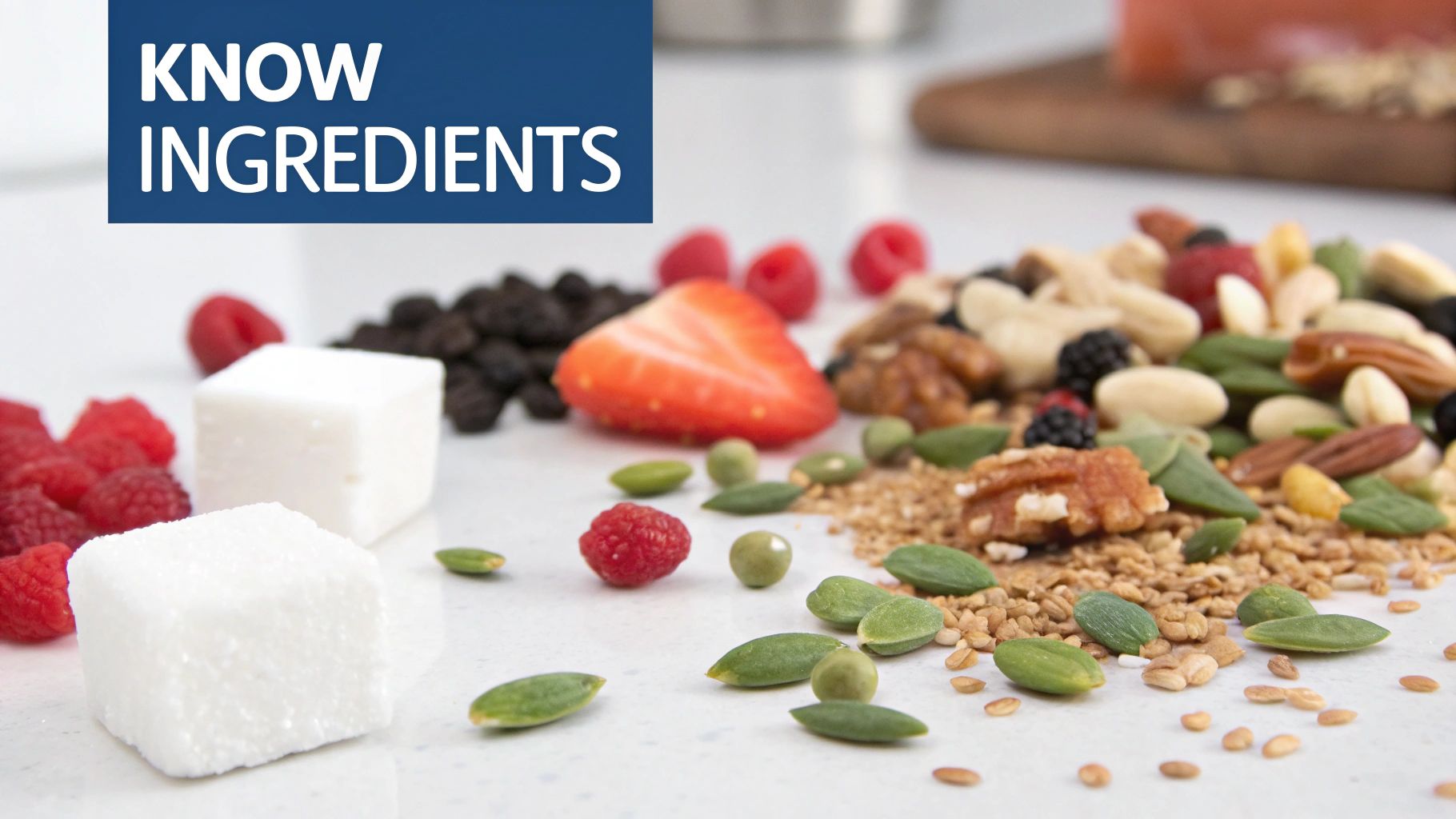
A quick glance here can reveal whether you're holding a snack packed with wholesome goodness or just a cleverly marketed cookie. It's the ultimate tool for improving your granola bar nutrition game.
The 'First Five' Rule
Here’s a simple but powerful trick I always use: the 'First Five' rule. The first five ingredients on any food label make up the bulk of what you're eating. If you see sugar, syrup, or refined flour in that top group, consider it a major red flag.
Imagine you're building a house. The first five ingredients are your foundation. You want that foundation to be strong and sturdy—built from whole grains, nuts, and fruit. If it's built on a foundation of sugar and white flour, the whole structure is going to be weak.
A bar that lists "Rolled Oats, Almonds, Dates" in its first five ingredients is telling a very different story than one that starts with "High Fructose Corn Syrup, Enriched Flour, Sugar." The first promises sustained energy; the second promises a sugar crash.
This simple check helps you quickly identify which bars are genuinely wholesome and which are just pretending. It's one of the fastest ways to make a better choice in the snack aisle.
Celebrating the Ingredient Heroes
When you're scanning that list, you want to see recognizable, whole-food ingredients. These are the nutritional powerhouses that provide real, lasting energy and benefits for your body. For parents looking for better kids snack bars and cookies, spotting these ingredients is a huge win.
Here are the heroes to look for:
- Whole Grains: Ingredients like rolled oats are the classic foundation of a great granola bar. They provide complex carbohydrates and soluble fiber, which helps keep you full and supports a healthy gut.
- Nuts and Seeds: Almonds, walnuts, chia seeds, and flax seeds are packed with healthy fats, protein, and fiber. These are the ingredients that give a bar real staying power.
- Real Fruit: Look for ingredients like dates, apricots, or berries. These add natural sweetness and a dose of fiber and vitamins, unlike empty-calorie refined sugars.
These ingredients work together to create a snack that actually fuels you and your kids through the afternoon, rather than just providing a quick, fleeting burst of energy.
Unmasking the Ingredient Villains
On the flip side, some ingredients are instant deal-breakers. These are the sneaky culprits that turn a potentially healthy snack into something far less desirable. They often hide in plain sight on the ingredients list.
Keep an eye out for these villains:
- Refined Grains: Terms like "enriched wheat flour" or "rice flour" mean the grain has been stripped of its most nutritious parts—the bran and germ. This leaves you with a simple carb that acts a lot like sugar in your body.
- Artificial Sweeteners: Ingredients like sucralose, aspartame, or acesulfame potassium are often used to create low-sugar bars, but their long-term health effects are still debated.
- Hydrogenated Oils: Also known as trans fats, these oils are used to extend shelf life but are seriously bad news for heart health. Avoid them completely.
- Unrecognizable Preservatives: If the ingredients list reads like a chemistry experiment with words you can't pronounce (like BHT or TBHQ), it's a sign the bar is highly processed. While some preservatives are necessary, simpler, more natural options are always better. You can learn more about the different types by exploring what are natural preservatives.
By learning to spot these good, bad, and sneaky ingredients, you move beyond just counting calories or sugar grams. You start to understand the quality of what's in your food, empowering you to make choices that truly nourish your family.
Navigating the Kids' Snack Aisle
Welcome to the kids' snack aisle—a dazzling wonderland of cartoon characters, bright colors, and promises of happy, satisfied children. It's a marketing masterpiece designed to make your little one grab a box and refuse to let go. For parents, though, it can feel more like a minefield.
This is especially true for kids snack bars and cookies. They look so convenient, so perfect for the lunchbox. Yet, many of them are just desserts playing dress-up, offering little more than a quick sugar rush that leads to the inevitable afternoon crash. But don't worry, you don’t have to surrender. With a few smart tips, you can conquer this aisle like a pro.
Why Kids' Snacks Are Different
Children aren't just tiny adults; their nutritional needs are unique. They need a steady supply of energy for their growing bodies and brains, but in smaller, more frequent doses. The best snacks provide lasting fuel from a balance of protein, healthy fats, and fiber—not a sugar bomb.
Unfortunately, many granola bars marketed to kids fail this test. They often lack the protein and fiber needed to keep kids full and focused. Instead, they double down on sugar and refined flour, making them more of a treat than a truly beneficial snack.
Think of a good snack as a small log on a fire, providing steady, slow-burning heat. Many kids' bars are like throwing a piece of paper on the fire—you get a big, bright flame for a moment, followed by a quick burnout.
The demand for healthier, convenient options is booming. The global granola bar market was recently valued at around USD 5.25 billion and is expected to grow to USD 7.69 billion in the coming years. This growth shows that parents are actively seeking out better snacks that fit their busy lives.
Your Game Plan for the Snack Aisle
Finding a genuinely healthy kids' snack bar doesn't have to be a scavenger hunt. By keeping a few simple guidelines in mind, you can quickly sort the good from the not-so-good. It’s all about focusing on quality ingredients and a balanced nutritional profile.
Here are some practical, non-judgmental tips for your next shopping trip:
- Aim for Low Sugar: For kids, try to find bars with 7 grams of sugar or less. An even better target is under 5 grams. Remember to check for added sugars, as those are the ones you really want to minimize.
- Prioritize Protein and Fiber: Look for at least 2-3 grams of fiber and a few grams of protein. These are the key to a snack that actually satisfies hunger and provides sustained energy for playground adventures or homework.
- Keep the Ingredient List Short: A shorter, simpler ingredient list is almost always a good sign. If you see whole foods like oats, dates, nuts, and seeds at the top, you're on the right track.
- Dodge the Dyes and Funny Stuff: Avoid bars with artificial colors, flavors, and preservatives. Real food doesn't need a chemical boost to taste good, and kids' bodies certainly don't need the extra additives.
By arming yourself with this simple checklist, you can feel much more confident about the choices you're making for your family. For more ideas, check out our guide on finding healthy snacks for kids.
Fun Alternatives to Packaged Bars
While a great store-bought bar is a lifesaver, it's also fun to mix things up. Thinking beyond the wrapper can open up a world of easy, nutritious, and kid-approved snacks.
Why not try one of these suggestions?
- Mini "Snack Skewers": Thread cheese cubes, grapes, and whole-grain crackers onto a small skewer.
- Apple "Donuts": Core and slice an apple into rings, then top with nut butter and a sprinkle of seeds.
- DIY Trail Mix: Let your kids build their own mix with nuts, seeds, whole-grain cereal, and a few dark chocolate chips.
Exploring a variety of healthy kid-friendly recipes can also provide amazing inspiration. With a little creativity, you can expand your snacking toolkit and make healthy eating an adventure.
How to Choose the Right Bar for YOU
Okay, you've learned how to read the labels and spot the ingredients that have no business being in your snack. Now for the fun part: putting that knowledge to work in the grocery aisle.
Instead of just handing you a list of "approved" bars that might change next month, I want to give you the tools to find your own winners.
The granola bar world is massive and it's not slowing down. The cereal bar market was recently valued at a whopping USD 17.88 billion and is expected to climb to USD 28.12 billion in the next six years. That growth is driven by people just like us, looking for convenient snacks that are actually good for you.
Let's break down the main types of bars you'll find so you can grab the perfect one for any situation.
High-Protein Powerhouses
Need something to crush that post-workout hunger? Or a snack that will actually hold you over until dinner? A high-protein bar is your best friend. These are built to be more filling and help with muscle repair and satiety.
- What to Look For: Aim for at least 10-15 grams of protein. You want that protein to come from real food sources like nuts and seeds, or high-quality options like pea or whey protein.
- Watch Out For: Don't let a high protein number trick you into ignoring the sugar. Some protein bars are just candy bars with a scoop of protein powder thrown in. Always, always check the sugar content.
Low-Sugar Winners
For a simple, everyday snack that won't send your energy levels on a rollercoaster, low-sugar bars are the way to go. They’re perfect for a light afternoon boost or for anyone trying to be more mindful of their sugar intake.
- What to Look For: The goal here is under 10 grams of total sugar, but the real champs often have 5-7 grams or less. You get bonus points if that sweetness comes from whole fruits, like dates, instead of syrups.
- Watch Out For: Make sure the bar isn't just swapping sugar for a long list of artificial sweeteners or sugar alcohols. For some people, those can cause digestive issues.
A truly great low-sugar bar doesn’t sacrifice flavor. It uses the natural sweetness and texture of its whole-food ingredients to deliver a satisfying, balanced snack.
Beyond just snacks, it always helps to understand the general principles of better nutrition to make smart choices for your overall diet.
Kid-Friendly Favorites
Finding a healthy bar your kid actually wants to eat can feel like a major win. The best options pack real nutrition into a tasty little package that can fuel them through school and playtime.
- What to Look For: A short, simple ingredient list is your best friend here. Look for under 7 grams of sugar (ideally 5 or less), a bit of fiber, and ingredients you can actually pronounce.
- Watch Out For: Be skeptical of bars with cartoon characters on the box. They are often the worst offenders for high sugar and artificial junk. Flip it over and let the nutrition label—not the flashy marketing—do the talking.
Simple Ingredient Champions
Sometimes you just want a snack that’s as close to nature as possible. These bars are all about minimalism, with short ingredient lists packed with things you recognize. They are the perfect pick for anyone looking for a clean, unprocessed option.
- What to Look For: That 'First Five' rule we talked about is everything here. The top ingredients should be things like oats, nuts, seeds, and fruit. A list with only 5-7 ingredients is a fantastic sign.
- Watch Out For: "Natural" doesn't automatically mean low-calorie. These bars are often dense with nutrients (and calories!), so just be mindful of the serving size if that's something you're tracking.
Your Top Granola Bar Questions, Answered
Alright, you’ve learned how to read labels, spot sneaky sugars, and even navigate the chaos of the kids' snack aisle. You're basically a granola bar pro at this point.
But there are always a few lingering questions that pop up. Let's tackle them head-on so you can walk into the grocery store feeling totally confident.
Are Homemade Granola Bars Healthier Than Store-Bought Ones?
Almost always, the answer here is a big, resounding yes.
Making granola bars at home puts you in the driver's seat. You have complete control over every single ingredient that goes into the mix. No more guessing games.
When you're the chef, you decide:
- The Sweetness Level: Want to use dates or a drizzle of maple syrup instead of high-fructose corn syrup? You can do that. You control the type and the amount.
- The Nutrient Boost: You can load them up with your family’s favorite good stuff—chia seeds, walnuts, pumpkin seeds, you name it.
- The "No" List: Say goodbye to artificial flavors, weird preservatives, and hydrogenated oils. You’re in charge of the guest list.
Sure, it takes a little more effort than grabbing a box off the shelf, but it’s often cheaper in the long run. Plus, it’s the perfect way to customize bars for allergies or specific health goals.
How Much Sugar Is Too Much in a Granola Bar?
This is the golden question, isn't it? For a good, everyday granola bar for adults, a great rule of thumb is to look for one with under 10 grams of total sugar. To make an even better choice, aim for less than 7 grams.
When it comes to bars for the little ones, you’ll want to be even more mindful. Sticking to 5 grams of sugar or less is a fantastic goal that helps keep their energy levels steady and builds healthy habits.
Remember, it’s not just about the number. Always peek at the ingredients to see where the sugar is coming from. Natural sweetness from whole foods like dates or berries will always be a better choice than added sugars like brown rice syrup.
Can Granola Bars Help with Weight Loss?
They definitely can, but it all comes down to which bar you choose and how it fits into your day. A granola bar that’s high in both protein and fiber can be a great tool on a weight loss journey.
That powerful combo of protein and fiber helps you feel full and satisfied, which can stop you from reaching for less-healthy snacks between meals. The flip side is also true—many granola bars are basically candy bars in disguise, packed with calories and sugar that can easily derail your efforts.
The key is to treat them as a portion-controlled snack, not a free-for-all treat. Choose wisely, and they can absolutely be part of a healthy weight management plan.
What Is the Difference Between a Granola Bar and a Protein Bar?
They might be neighbors on the grocery store shelf, but they have very different jobs. The main difference is their primary purpose.
- Granola Bars: These are typically oat-based and built to deliver carbohydrates. Their main goal is to give you a quick and convenient source of energy. Think of them as fuel for a hike or a way to power through that 3 p.m. slump.
- Protein Bars: As the name suggests, these are formulated to pack a serious protein punch—often 15-20 grams or more. They’re usually tied to fitness goals, like helping your muscles recover after a workout, or serving as a more substantial snack that keeps you full for longer.
While some granola bars have a little extra protein and some protein bars have oats, their core missions are different. One is for energy, the other is for protein. Knowing what you need will help you make a much better choice.
At Skout Organic, we believe snacking should be simple and joyful, not a nutritional puzzle. We create delicious, plant-based kids' snack bars and cookies with organic ingredients you can actually pronounce. Explore our family-friendly options and build your own custom snack box today.